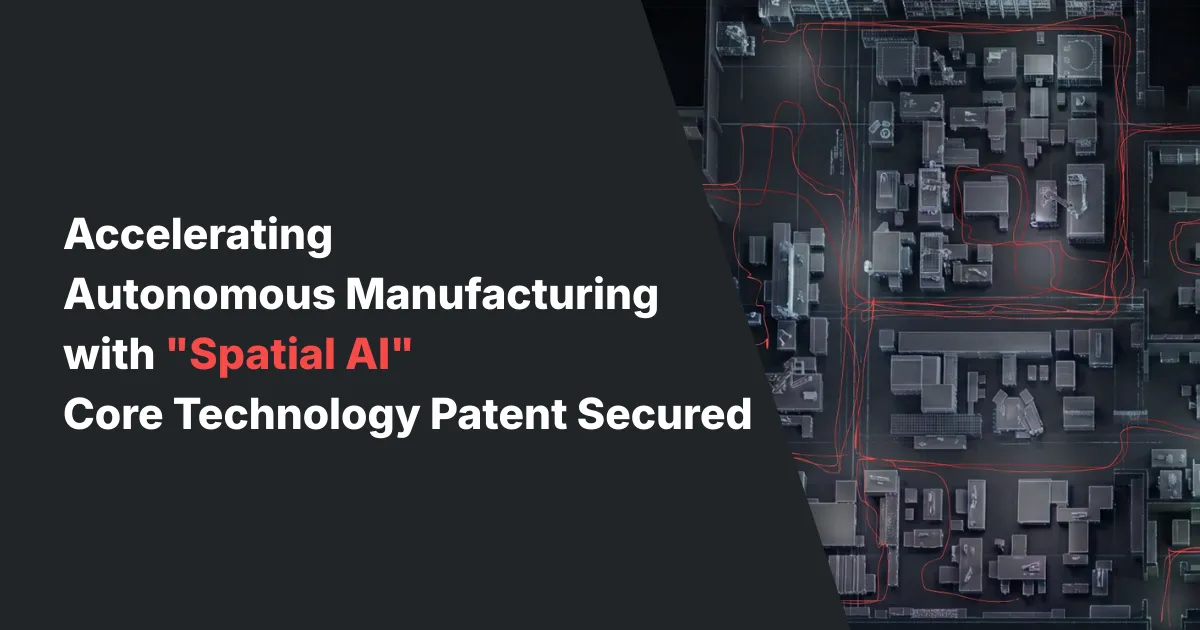
Visualizing “Hidden Know-how and Wasted Movement” with a Single Smartphone—Revolutionizing Operations in the Industrial Sector.
Zeteoh Inc. (Headquarters: Chuo-ku, Tokyo; CEO: Yann Le Guilly), a developer of industrial AI, has officially secured a patent for its core technology, “Spatial AI.” This technology enables the real-time tracking of “when, where, and how people, robots, and materials move” within manufacturing environments.
This breakthrough achieves “high-precision positioning without the need for infrastructure,” a feat previously considered difficult to attain. In a manufacturing industry facing a worsening labor shortage, zeteoh strongly supports the transition to “Autonomous Factories”—facilities that maximize productivity with limited personnel. The advancement of this business and the patent acquisition were made possible through multi-faceted support from addlight Inc., acting as the FY2024 development promoter for the Tokyo Metropolitan Government’s startup support project, “Tokyo NEXT 5G Boosters Project.”
🔶 What is Spatial AI?
Spatial AI is artificial intelligence trained on physical operational data from the real world. It understands and predicts, in a digital real-time environment, how people, robots, and materials move and interact within a facility.
While “Language AI (LLM)” understands text and “Visual AI” understands images, Spatial AI understands “space and movement.” By visualizing the dynamics of the shop floor—which were previously a “black box”—Spatial AI serves as a next-generation industrial foundation that enables the shift to autonomous factories, maximizing productivity with minimal staff.
🔶 Impact on Factory Operations: Saving the Equivalent of 160M JPY Annually for a 100-Person Factory
While Japan’s industrial labor force is projected to decline by 20% by 2040 [1], the trend of “reshoring” (bringing production back to Japan) is accelerating. To resolve this contradiction, it is essential to realize “Autonomous Factories” by accurately capturing real-time dynamics and optimizing operations.
According to estimates by zeteoh (referencing McKinsey & Company reports [2]), up to 30% of work on manufacturing floors is spent on “non-productive movement and searching.” For a facility with 100 employees, this equates to an annual loss of approximately 165 million JPY. Until now, digitizing and understanding these movements required the installation of expensive hardware, which hindered data collection.
🔶 Why Has AI Struggled to “Understand” Factories?
Large Language Models (LLMs), such as ChatGPT, revolutionized office work by learning from vast amounts of data on the internet. However, on the factory floor, physical dynamic data—such as “how workers move and where bottlenecks occur”—does not exist on the internet. This “lack of physical data” is the primary reason AI applications in manufacturing have been limited to narrow scopes like predictive maintenance.
🔶 Practical Application: Infrastructure-Free Positioning via “TRAILS”
zeteoh provides its Spatial AI through the spatial intelligence platform “TRAILS.”
The first feature available through TRAILS is worker positioning. This tracks the location of people within a facility without installing beacons, cameras, or sensors. In practice, staff simply carry a smartphone with the app installed, allowing operations to begin within hours to a few days.
The system achieves an accuracy of 1 to 2 meters, comparable to traditional beacon-based solutions that require heavy capital investment. From day one, TRAILS visualizes “hidden losses” using nothing more than a smartphone.
🔶 The Value of TRAILS: From Positioning to Autonomy
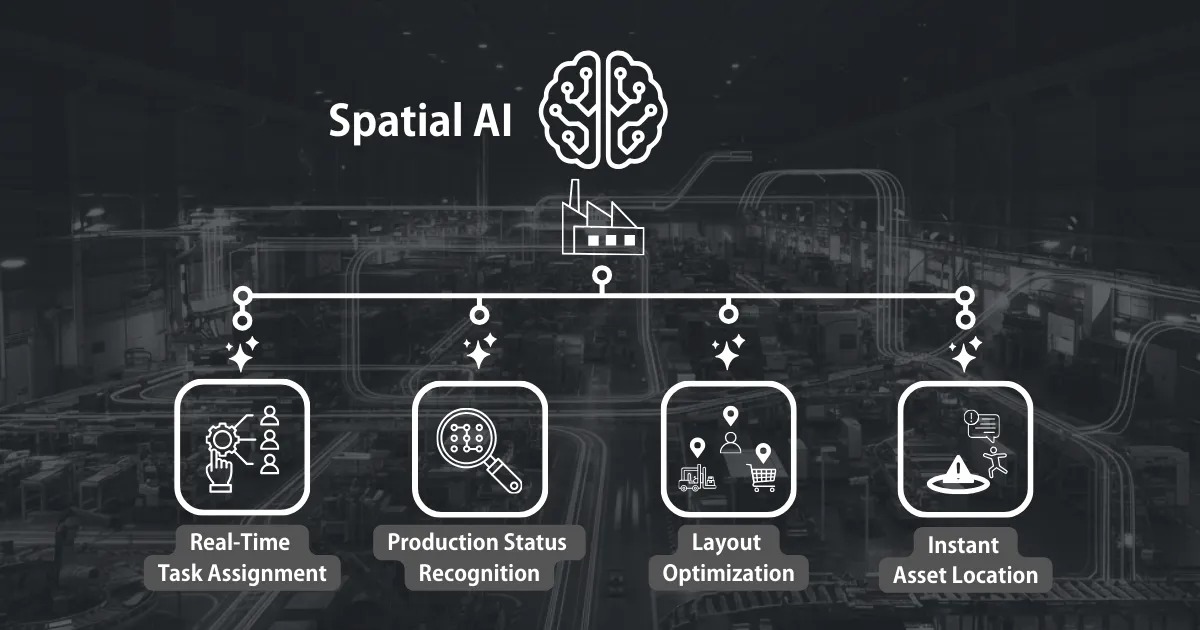
Spatial AI will sequentially roll out the following functions:
-
Real-Time Task Assignment: Automatically directs workers and robots to where they are needed most based on their current location and the next required task.
-
Production Status Recognition: Visualizes whether a production line is running normally, delayed, or experiencing an anomaly based on the movement patterns of workers.
-
Layout Optimization: Real-time reconfiguration of the most efficient pathways and work zones based on workload changes to maintain the shortest possible lines of movement.
-
Instant Asset Location: Locates tagged tools, carts, or equipment instantly, reducing “searching time”—a major component of wasted movement—to zero.
-
Safety Monitoring: Detects entry into hazardous areas or worker fatigue, issuing alerts to prevent accidents before they occur.
🔶 Comment from Yann Le Guilly, Founder & CTO
“While ChatGPT learned from internet data, our Spatial AI learns from the actual factory floor. Just as language models have become indispensable for the modern office, I am confident this technology will become an essential infrastructure for the future of manufacturing.”
🔶 About Zeteoh Inc.
Founded in 2020, zeteoh is a Japan-based deep-tech startup opening the final frontier of industrial autonomy: the digitization of “human movement” and “business processes” in physical space.
Out of over 4,800 applicants from 108 countries, zeteoh was selected as a “Deep Tech Pioneer” for its outstanding innovation at Hello Tomorrow, the world’s most prestigious deep-tech competition. The company’s platform, TRAILS, reduces infrastructure investment by 90% and can be implemented using existing smartphones.
The company has been selected for prominent programs including JETRO, STATION F (France), Creative Destruction Lab Paris, and the Industry 4.0 Accelerator (USA). With advisors such as Karl-Gustaf Eklund (Former CEO of Volvo Cars Japan) and Samir Hamoudi (Former Google Maps Manager), zeteoh is accelerating manufacturing DX on a global scale.
Sources:
[1] The Japan Institute for Labour Policy and Training (JILPT), “Projections of Labor Force Supply and Demand (2023 Edition)” https://www.jil.go.jp/institute/siryo/2024/284.html
[2] McKinsey & Company, “Designing data governance that delivers value.” https://www.mckinsey.com/capabilities/tech-and-ai/our-insights/designing-data-governance-that-delivers-value